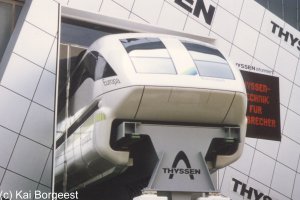
Possibly the most controversial aspect of the design
is that of being "at grade", meaning it runs at ground level. The
concern is not that vehicles would collide with automobiles (they
don't coexist), but rather with pedestrians, bicycles,
and such. This is no doubt a challenging engineering hurdle, but
recent developments in robotics made possible by the
DARPA Grand Challenges suggest that machine will inevitably
be safer than humans.
Unlike the DARPA vehicles, PRTProject
vehicles are confined to rails. So the challenge is not
"what direction" but rather "is it safe to proceed".
Furthermore the sensory input into the system is not limited to
what's mounted on the vehicle, but instead includes the combined
sensory input of every vehicle in the system, input from a
command center, and sensing
equipment embedded into the infrastructure.
While the DARPA Challenges have a military objective, I believe
the greatest benefit will ultimately be to the field of transportation.
PRT scales extremely well.
The vehicles are controlled at two distinct
levels: an onboard vehicle control system (VCS) handles local functions
(opening doors, user safety, etc) and a central control system (CCS)
monitors and routes the fleet according to the needs of the system.
VCS (Vehicle Control System)
The VCS is in constant communication with
the central control
system. The VCS utilizes onboard video cameras and motion sensors to monitor activity both
outside and inside the vehicle. Outside sensors allow the
vehicle
to track and avoid obstacles such as children, animals, or other
vehicles. Inside systems allow the vehicle to detect when
passengers are safely seated, and so forth. The VCS interacts
with passengers via voice recognition to interpret commands ("stop
here", "take me to school", etc). Each passenger
has a profile in the system such that "school" has a specific meaning
depending on the user. A touch screen is also provided
as an additional way of communicating with the passenger, displaying
route maps, event times, etc.
CCS
(Central Control System)
The vehicle communicates with the
central control system (CCS) to receive routing instructions and
communicate various events across the system (a dog on the tracks, etc).
As a safety precaution, either
system (VCS or
CCS) can bring the vehicle
to a full stop. Likewise both systems must approve of all vehicle
movement. The result is that, even if the CCS sends faulty
instructions, the vehicle will still have sufficient
onboard intelligence to detect and prevent collisions.
Alternatively, if a vehicle is malfunctioning, the CCS will detect the
behavior through GPS tracking and initiate a shutdown of the vehicle, if
necessary by triggered by stop points on the tracks
(described later).
This redundancy of control insures the safety of the total system.
While control is shared between the VCS and CCS, the passenger always
has the final word due to safety reasons. The passenger can always
stop the vehicle in the event of an
emergency (fire, etc).
Propulsion
PRT vehicles are powered by a 3rd
electrified rail, running a non-lethal 48V. A battery in
included in the design, but only for bridging unpowered sections of
track and conditioning the power input.
NOTE: When this concept was conceived in 2012,
vehicle battery technology was significantly less advanced. Given
modern improvements in energy density and sustainability, onboard
battery power is an additional viable option alongside direct rail
electrification.
The vehicles do not
have a designated front or back, but instead travel equally well in either direction.
While conventional trains and lightrail
systems rely solely on gravity to keep vehicles on the track,
the PRT vehicle is considerably lighter
and requires
an additional set of guide wheels for safety purposes, similar to that employed
with roller coasters. The
guide wheels are mounted such that
they connect with the inner side of the rails. Those
illustrated here are probably more extensive than what
would actually be needed for PRT vehicles.
Vehicle Specialization
PRT vehicles are a shared public
resource, available on demand, rather than individually owned. While the
majority of the
vehicles will be dedicated to
basic passenger service, the system also provides for
specialized vehicles...
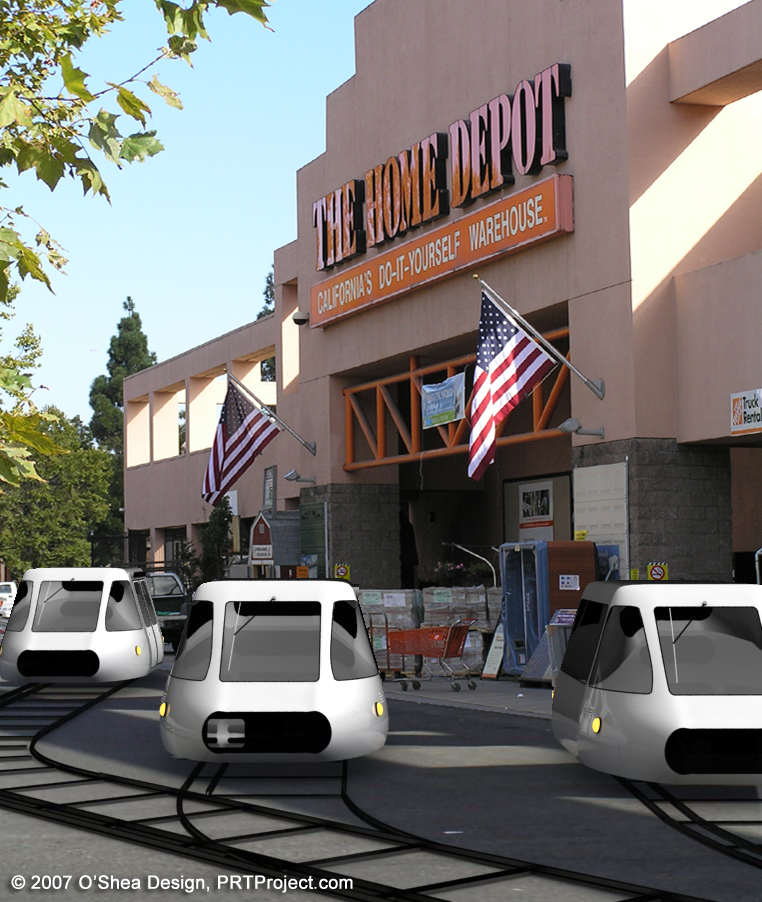
If an individual were to make a large
purchase at the local hardware store, a specialized freight vehicle
would be summoned. This fulfills the need of
individuals who currently own pickup trucks for occasional
weekend home improvement projects in a much more economical
way.
Specialized
freight PRT vehicles will also replace the need for
traditional truck and train transport. On the occasion
where excessively large objects need to be moved (crane,
etc), side access roads can be utilized. Remember, PRT
tracks require only a fraction of the existing road surface,
leaving the remainder for foot & bicycle traffic, and
service access as just mentioned.
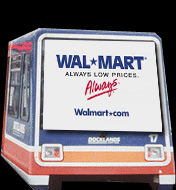
Vehicles can be leased
to businesses for a variety of customizations, although
modification of underlying chassis or mechanics would not be
allowed.
Vehicles in this category would not receive preferential
routing.
Vehicles will also be
customized for government functions such as emergency services
- police, fire, and ambulances. Vehicles of this sort
would receive priority routing and include manual control overrides
for dealing with emergency situations.
As with conventional rail systems,
the PRT system itself will also require specialized vehicles
to handle track repair and inspections, clear debris from the
rails,
and so forth.
There may also be specialization within
passenger vehicles, possibly a one-person unit since most travel
consists of a single passenger.
Bicycle-Weight Technology
Without the danger of vehicle to vehicle, or vehicle to
stationary object collisions, there is no need for mass
designed solely for protection. An automobile at standard occupancy weighs a ton per
passenger. An Amtrak car - 1200 pounds. A bicycle - 20 pounds.
Track Design
Traditional rail systems run parallel to the
existing roadways, requiring vast infrastructure investments due to raised
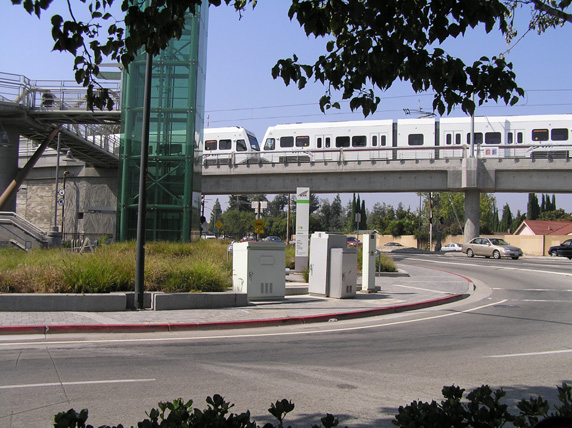
platforms, tunnels, and land acquisitions. Lightrail systems can
cost as much as $70 million per mile and take
years to construct even short distances.
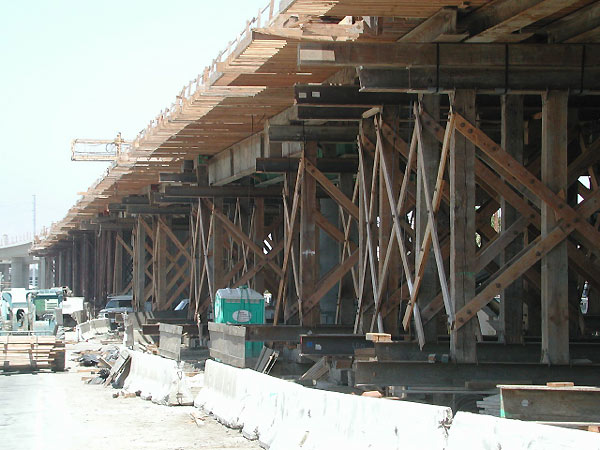
The PRT rails are instead mounted atop the existing road surfaces,
greatly reducing the construction costs and implementation times.
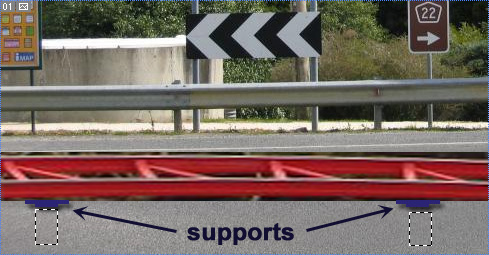
The
tracks are supported
at periodically spaced columns embedded into the ground. The intersection of the columns and the
track would be designed to allow adjustments to compensate for ground
settling, keeping the tracks extremely level. Tracks segments could
also be detached from the columns during street maintenance (underground
utility work, etc). The paved surface below the
rails would last much longer since it would no longer be experiencing
direct traffic, a
significant cost savings.
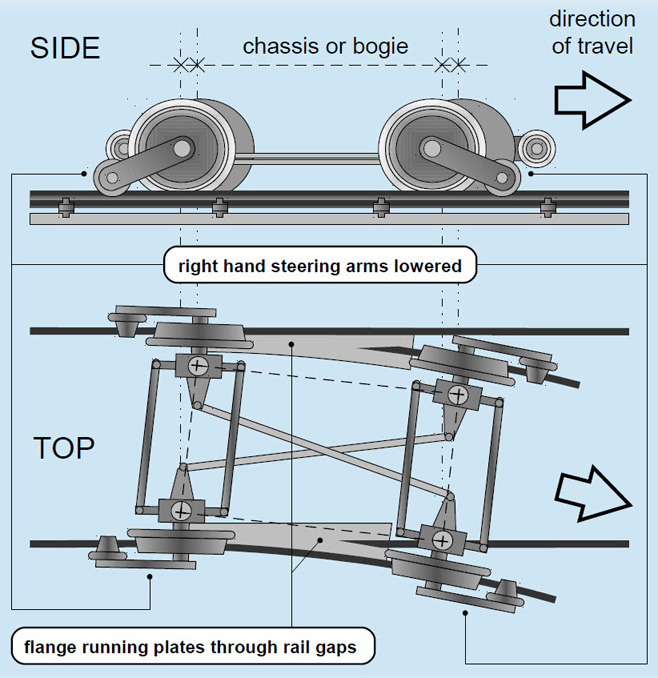
Device For On–Board Rail Vehicle Switching Passive track infrastructure with self
steering wheelbase guided by interlocked movable steering arms.
Courtesy of Mark E Townend, 09/04/2013 http://www.townend.me/files/onboardswitch.pdf
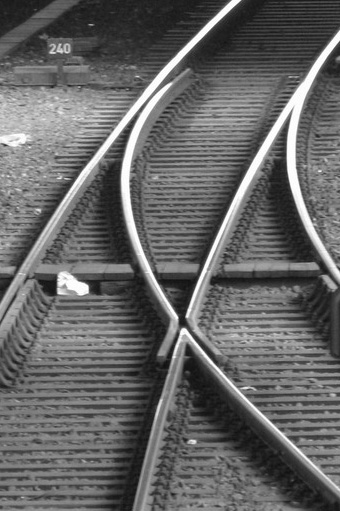
PRT uses "in-vehicle" switching.
This means the vehicles control the switching operation, providing the mechanical energy
necessary to throw the switch, thus simplifying the switches themselves. It
will be important to keep the cost of the switches low given the large
quantity required. In trains, faulty or incorrectly set switches are
often the cause of accidents. To address this concern, the central
routing system will assume that the vehicle is still on the main line
until (1) the vehicle reports the exit as successful and (2) a sensor in
the sidetrack verifies the vehicle location.
The design criteria for passenger loading
/ unloading requires that no single vehicle blocks another. So if
a neighbor is busy loading luggage into a vehicle, you would not be
late for work. So the only delay would be it time it takes the
vehicle to arrive. If the central routing system detects a
pattern, say you leave for work every weekday morning at 7:00am, it will
proactively start sending a vehicle to your location in anticipation of your
need.
residential track layout
At locations involving high volume
loading / unloading, such as the local mall, people would line up for
the next available vehicle (a "taxi line"). Such a location would
maintain multiple sidings, depending on volume.
customers queuing up for vehicles
At key points on the track, stop
points will be implemented, controlled by the central
routing system. If a stop point is activated, any passing
vehicle is disabled (stopped) when it makes contact. This is a
safety precaution in the event of a runaway vehicle.
This much rail covering our streets will
certainly be a challenge, especially to pedestrians and bicycles.
At numerous key points we will need appropriate ramping to make crossing
safer, especially at locations where the rails and path cross at
diagonals. Here's one technology that handles the task...
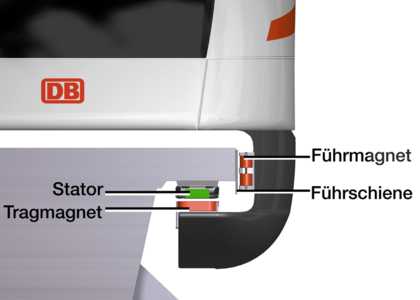
While
the current PRT design calls for steel wheels on conventional
steel rails, there's also the possibly of utilizing maglev or
hover technologies. MAGLEV has it's advantages, but given
the low speed and large amount of track involved with the PRT, MAGLEV technology
may not be a good fit for PRT.
Here are a few good links on the subject...






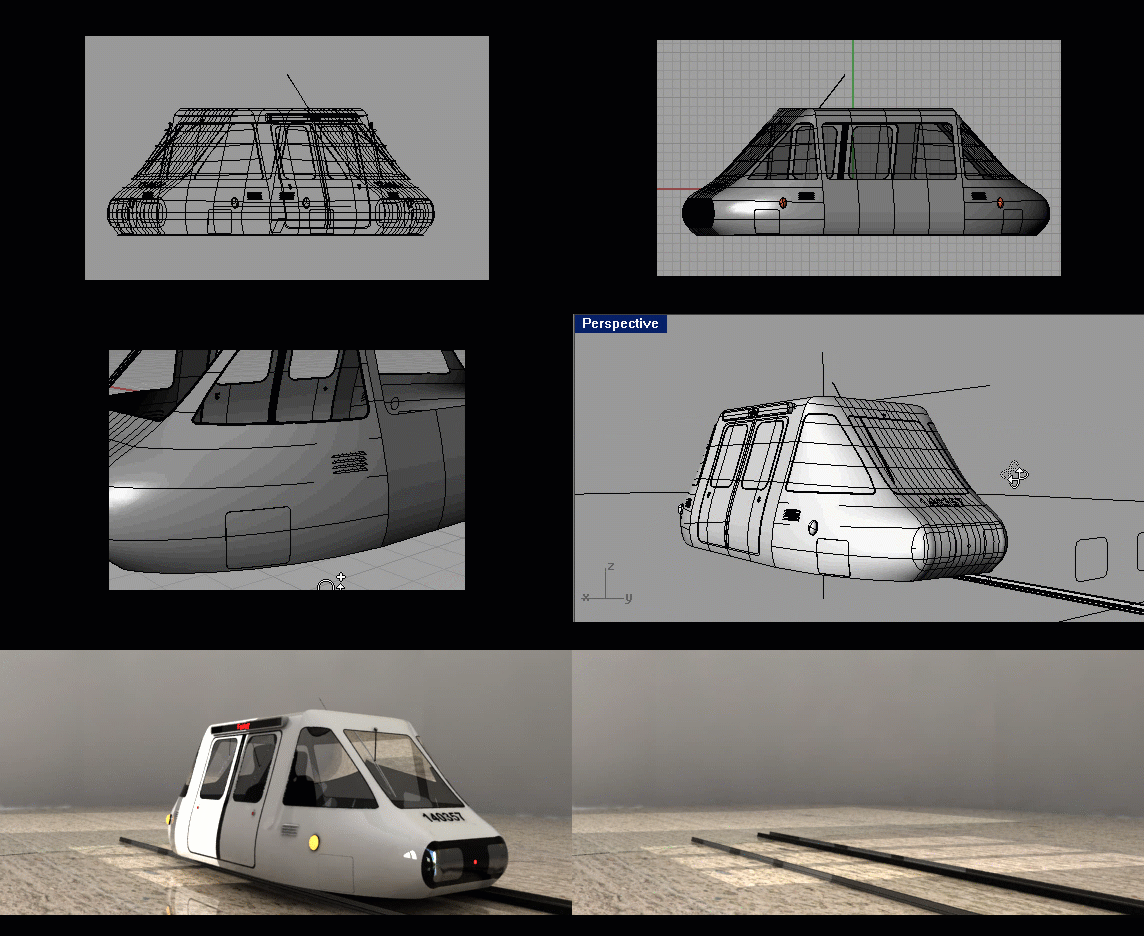
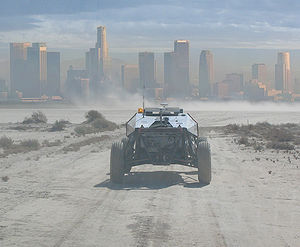
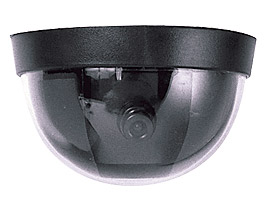 vehicle
to track and avoid obstacles such as children, animals, or other
vehicles. Inside systems allow the vehicle to detect when
passengers are safely seated, and so forth. The VCS interacts
with passengers via voice recognition to interpret commands ("stop
here", "take me to school", etc). Each passenger
has a profile in the system such that "school" has a specific meaning
depending on the user. A touch screen is also provided
as an additional way of communicating with the passenger, displaying
route maps, event times, etc.
vehicle
to track and avoid obstacles such as children, animals, or other
vehicles. Inside systems allow the vehicle to detect when
passengers are safely seated, and so forth. The VCS interacts
with passengers via voice recognition to interpret commands ("stop
here", "take me to school", etc). Each passenger
has a profile in the system such that "school" has a specific meaning
depending on the user. A touch screen is also provided
as an additional way of communicating with the passenger, displaying
route maps, event times, etc. system (VCS or
CCS) can bring the vehicle
to a full stop. Likewise both systems must approve of all vehicle
movement. The result is that, even if the CCS sends faulty
instructions, the vehicle will still have sufficient
onboard intelligence to detect and prevent collisions.
Alternatively, if a vehicle is malfunctioning, the CCS will detect the
behavior through GPS tracking and initiate a shutdown of the vehicle, if
necessary by triggered by stop points on the tracks
(described later).
This redundancy of control insures the safety of the total system.
system (VCS or
CCS) can bring the vehicle
to a full stop. Likewise both systems must approve of all vehicle
movement. The result is that, even if the CCS sends faulty
instructions, the vehicle will still have sufficient
onboard intelligence to detect and prevent collisions.
Alternatively, if a vehicle is malfunctioning, the CCS will detect the
behavior through GPS tracking and initiate a shutdown of the vehicle, if
necessary by triggered by stop points on the tracks
(described later).
This redundancy of control insures the safety of the total system.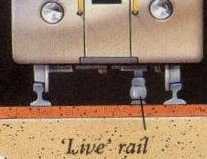

 the switch, thus simplifying the switches themselves. It
will be important to keep the cost of the switches low given the large
quantity required. In trains, faulty or incorrectly set switches are
often the cause of accidents. To address this concern, the central
routing system will assume that the vehicle is still on the main line
until (1) the vehicle reports the exit as successful and (2) a sensor in
the sidetrack verifies the vehicle location.
the switch, thus simplifying the switches themselves. It
will be important to keep the cost of the switches low given the large
quantity required. In trains, faulty or incorrectly set switches are
often the cause of accidents. To address this concern, the central
routing system will assume that the vehicle is still on the main line
until (1) the vehicle reports the exit as successful and (2) a sensor in
the sidetrack verifies the vehicle location.
 While
the current PRT design calls for steel wheels on conventional
steel rails, there's also the possibly of utilizing maglev or
hover technologies. MAGLEV has it's advantages, but given
the low speed and large amount of track involved with the PRT, MAGLEV technology
may not be a good fit for PRT.
Here are a few good links on the subject...
While
the current PRT design calls for steel wheels on conventional
steel rails, there's also the possibly of utilizing maglev or
hover technologies. MAGLEV has it's advantages, but given
the low speed and large amount of track involved with the PRT, MAGLEV technology
may not be a good fit for PRT.
Here are a few good links on the subject...