This is a list of the top ten advantages of a PRT
system...
1) Computers drive better than you do
When driving a car and you see a red
light ahead, you allow the vehicle to decelerate in
anticipation of the stop. This is smart
driving at a modest scale. But in a fully automated system like the PRT, the entire route is
precalculated from beginning to
end, not just to the next intersection. As a
result, stopping at intersections becomes an antiquated
concept as computer control would time vehicles so as to
weave the traffic together seamlessly.
Proof that future
transportation must be fully automated
When a child runs onto the tracks, a human attempts to
break or swerve to avoid the obstacle. This can
lead to loss of control of the vehicle. Or if the
driver doesn't see the child, there is no attempt to stop
is even made. But with computer
controlled vehicles utilizing image recognition
and motion detection technologies, the reaction time is reduced
to milliseconds and braking is applied
at precisely the optimum rate. Computers are not
distracted by noisy children or cell phones.
Nighttime vision is achieved through infrared cameras. Finally,
there would be no chain reaction collisions as every vehicle
in the system is aware of every other, reacting
appropriately.
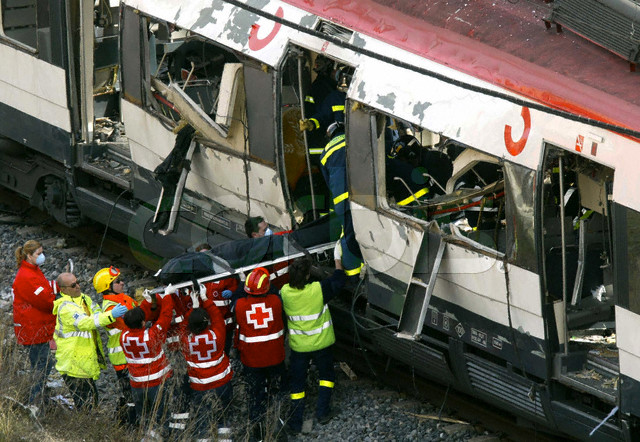
Every ten minutes someone is killed in
an automobile accident in the US. That's over
40,000 fatalities a year. That's also the number
of lives that could be saved if we weren't reliant on
human driving skills.
2) Convenience
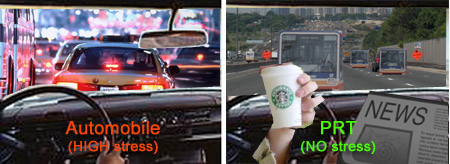
Commuters would no longer have the
stress of driving in traffic, allowing them to
concentrate on leisure activities like reading a book or enjoying their coffee. No more struggling
with maps or wondering which route would best avoid
traffic. Luxury is an unintended benefit of the
system.
3) Accessibility
To own a car, you need to know how to
drive. With PRT everyone has the freedom to
travel. Children can travel to and from school
without the parents. The elderly maintain their
mobility long after eyesight or reaction times have
diminished. The handicapped
are likewise empowered, summoning specially equipped vehicles
as appropriate.
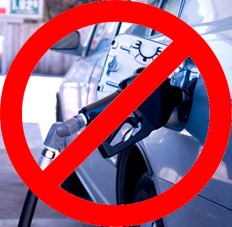
4) No
more gasoline
PRT vehicles use electric motors,
powered from a 3rd rail 48V (non-lethal) source. Electric
engines are
less expensive, more reliable, and easier to
maintain. Electric vehicles are quieter and do not
pollute the air. Service
stations are a relic of the past. Electrical energy still requires a source - nuclear,
solar, or burning of fossil fuels, but generating energy
in a central location is considerably more efficient
than burning gasoline in millions of individual
combustion engines. PRT is energy source agnostic.
5)
Economical
The challenge of introducing any new
transportation system is competing with the enormous
investment we already have with the existing system,
namely the automobile. The PRT addresses this
problem by taking over the existing roads, bridges, and
underpasses instead of attempting to build a parallel
infrastructure. The vehicles themselves are much
smaller than traditional light rail vehicles, which
means the rails do not need to be of the same gauge.
This would also be a savings. Finally, the
existing automobiles would not simply be scrapped, but
gradually resold into the outlying areas where the PRT
has not reached. So the new vehicle market will go
away, but existing vehicles will complete their normal
lifecycles.
6) No more parallel parking.
In fact, no more parking.
If you look outside you see
parking lots and driveways. Millions of acres
are paved over with asphalt and concrete for storing
idle cars.
More land is dedicated to parking lots than parks. With
the PRT just the opposite will be true. Millions
of acres will be reclaimed for better uses. Some
land will be required for overflow and
maintenance of PRT vehicles, but since the vehicles are
in continuous service, only a tenth the number of PRT
vehicles will be needed compared to automobiles.
7)
Terrorism-resistant
We live in a
world where
terrorism must be factored into the design of any transportation system.
If you design a bullet train to travel at 300 mph with 2000 passengers,
the potential for catastrophy from terrorism (or an accident) is great. On the
other hand if each vehicle is independent and travels at
modest speeds (45 mph), the potential for death from terrorism greatly
diminished. One requirement of the design is that control is shared
between a central routing system and the individual vehicles, with each
system able to independently halt the vehicle. This failsafe design would
prevent someone from overriding the central routing system and
intentionally causing collisions.
8) Proven technologies
The advantage of the
PRT system is that the design is based well established
technologies....electric motors, routing software, rail
switching, and so forth. It does not depend on the
development of alternative fuel technologies or fanciful
schemes for breaking the sound barrier. PRT
can be implemented today.
9) Willing developers
The public expenditure to
manage development of the PRT would not be
insignificant, however the scale of the potential
contracts to be awarded is such that many major
corporations would be very motivated to develop competing
designs...General Electric, Ford, GM. Toyota, Lockheed,
and so on.
10)
Good riddance
Many aspects of our lives
will simply go away. Stop lights. Speed
bumps. Traffic tickets. Traffic.
Service stations. Auto insurance (or lack
thereof). Streetlights. Car dealerships.
Flat tires. Oil changes. High speed car chases.
Parking meters. Drunk driving. Running
lights. Rubber-necking. Horns. Car
pool lanes. Smog tests. The DMV. The
list is endless...






 less expensive, more reliable, and easier to
maintain. Electric vehicles are quieter and do not
pollute the air. Service
stations are a relic of the past. Electrical energy still requires a source - nuclear,
solar, or burning of fossil fuels, but generating energy
in a central location is considerably more efficient
than burning gasoline in millions of individual
combustion engines. PRT is energy source agnostic.
less expensive, more reliable, and easier to
maintain. Electric vehicles are quieter and do not
pollute the air. Service
stations are a relic of the past. Electrical energy still requires a source - nuclear,
solar, or burning of fossil fuels, but generating energy
in a central location is considerably more efficient
than burning gasoline in millions of individual
combustion engines. PRT is energy source agnostic.